Partick Yeagle
Illinois Times
July 12, 2012
Springfield could raise money for infrastructure improvements from video gambling if the city council approves a measure introduced last week. Springfield mayor Michael Houston introduced a proposal to allow video gambling in Springfield, incorporating a 2009 state law that legalizes video gambling terminals in bars, hotels, banquet halls and other facilities. The state law and Springfield’s proposed ordinance are meant to regulate and tax the common practice of operating the machines semi-legally and paying out winnings under the table.
William McCarty, director of Budget and Management for the City of Springfield, says the proposal could help fund needed improvements to roads and other infrastructure. He said Houston has opted to “put off any type of bonding program for infrastructure so we can ascertain how much revenue this could raise.” That number is anybody’s guess, McCarty said.
The proposed ordinance would require operators, establishments and suppliers to register with the city and pay a $500 yearly fee. Each machine operated would incur an additional $250 yearly fee. That’s on top of fees paid to state regulators, which range from $5,000 to $50 per year. Manufacturers and distributors must pay the state up to $10,000 per year.
The proposal would give the mayor power of approval, and applicants would have to meet the same criteria as required for a liquor license.
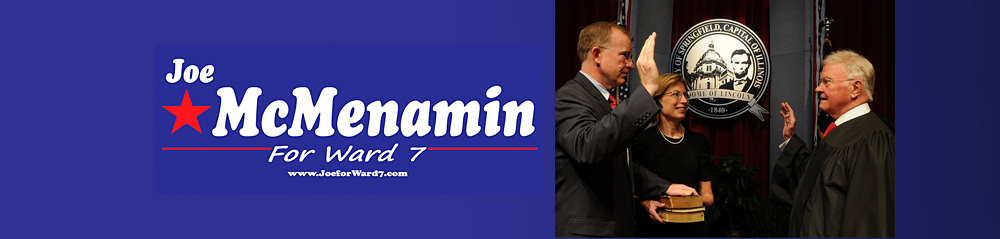
While several aldermen have expressed support for lifting the ban for video gambling, Ward 7 Alderman Joe McMenamin says he’s uncomfortable with the mayor’s office having the exclusive power of approval for video gambling licenses. He says the full city council should vote on license approval. “I think in a democracy, it’s wise to have checks and balances,” he says. “That [the original proposal] strikes me as giving the mayor too much discretion.”
Asked why the city council wouldn’t vote on video gambling licenses as it does with liquor licenses, Mark Cullen, the city’s head attorney, said the difference lies in the number of licenses available. “The reason the council votes on liquor licenses is the limited number of licenses,” Cullen said. “The council has to vote to increase the number of liquor licenses. In this case, we weren’t considering putting a cap on the number of video gaming licenses.”
Without a cap on licenses, McMenamin predicts a proliferation of small gambling shops in Springfield, similar to payday loan shops. McMenamin says he also disagrees with the original proposal’s wording, which he says “pre-approves all futureforms of gambling which the Illinois General Assembly might authorize in the future.” He says he has asked Cullen to draft an amendment specifying that the ordinance only approves the 2009 video gambling law.
“I’m in favor of regulated video gambling, but I don’t want to open the door any wider than that,” McMenamin says. “Gambling can be a wretched vice, and it can destroy marriages. It can destroy families. It can create lots of problems. I think we have to be careful about a proliferation of gambling.”
At least seven establishments in Springfield have applied for state licenses to operate video gambling machines, including three bars, two veterans organizations, and two gas stations owned by the same company.
McCarty says Houston’s administration expects plenty of local establishments to apply for video gambling machines, but it’s impossible to know how many. “There’s been a pretty good amount of interest,” he says. “Until people start signing up, we just can’t say. Quite honestly, we’re all pretty convinced there is a lot of interest out there and a lot of people are just sitting back, waiting to see what happens.”
Read the full article at illinoistimes.com
 Joe McMenamin for Ward 7