Crystal Thomas
The State Journal-Register
After haggling over a contract, the city of Springfield is one step closer to becoming a full-fledged member of the countywide economic development corporation. The contract, which aldermen will discuss and possibly vote on at their next city council meeting on June 5, lays out the city’s expectations for the Land of Lincoln Economic Development Corporation in exchange for $250,000 from city coffers. It is the last significant piece of funding the EDC needed; Sangamon County approved its $500,000 agreement with the EDC in early April.
Much of the city’s agreement contains the same language as that of the county’s, according to the EDC’s sole employee, Josh Collins.
Areas of concern emphasized by Springfield Mayor Jim Langfelder included making sure information was available to the public, having minority representation and participation and putting an emphasis on targeted industry attraction, according to Collins.
Langfelder was initially resistant to committing significant funds to an EDC, especially with the city’s recurring deficit. While the county initially asked the city to pitch in $500,000, Langfelder had $100,000 slotted into his proposed budget. Because the city raised taxes to cover part of the deficit, aldermen and Langfelder compromised on $250,000.
A change in the structure of the EDC’s board of directors has assuaged many of the city’s concerns.
Since the EDC’s inception, the structure of its board has changed to include more members than those who contribute between $25,000 to $50,000, in effort to increase diversity. Those who do contribute at that level will be voting members, Collins said, and can appoint other individuals who have not contributed financially to the board of directors.
The city’s agreement also specifies that the EDC engage groups who have not traditionally been involved in economic development in the past, such as ethnic minorities, women and young people. It also will collaborate with the city to develop resources to support minority business growth and convene a roundtable of diverse business owners.
Both the city and county contracts mandate annual audits, internal financial controls and quarterly public information reports to make sure tax dollars are being spent wisely, Langfelder said. The EDC will host biannual meetings with company presidents and the mayor to identify obstacles to expansion, workforce training needs and complementary vendors and businesses to attract.
Langfelder said he wanted to see the EDC build on the city’s strengths, by expanding the medical, insurance and financial, education, and arts and entertainment industries in Springfield.
What aldermen think
Most of Springfield’s aldermen support an EDC and think it’s worth the $250,000 investment. Several touted the changes made to include more minority participation and noted the high level of engagement they’ve seen from the greater business community.
Neither the Springfield Office of Planning and Economic Development nor the Springfield Convention and Visitors Bureau have permanent directors, and some said the EDC was the boost the city needed.
Almost all of the aldermen noted that markers of success for the EDC would be the numbers of jobs created. Several aldermen wished for more blue-collar jobs.
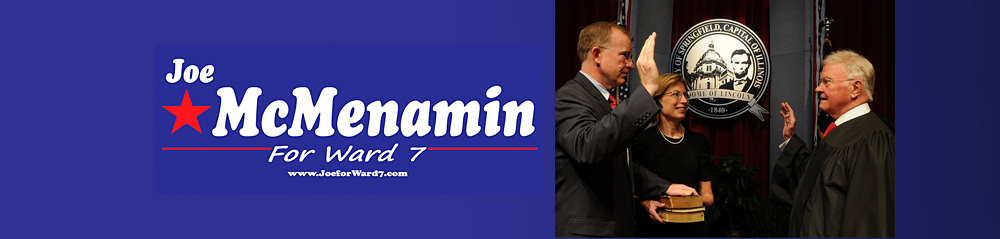
Ward 7 Ald. Joe McMenamin said he would be a “no” vote on the EDC, saying he didn’t think the city could afford to fund the new venture.
“I think city government should concentrate on public safety and infrastructure,” McMenamin said. “That quarter of a million (dollars) is new spending at a time we are running deficits. It’s a typical mistake of government to pass a sales tax increase and then we create a new spending program.”
***
 Joe McMenamin for Ward 7