Bruce Rushton
The Illinois Times
If you think there are a lot of politicians on the make in Springfield, you’d be right.
Thirty-two candidates are vying for 13 municipal offices in the upcoming April 2 municipal election. Three citywide races – for mayor, city clerk and treasurer – each have two candidates apiece. Twenty-six candidates, the most in at least two decades, are running for city council, where just two of 10 races are uncontested.
“It’s a weird time – it really is,” says Brad Schaive, Laborers Local 477 business manager.
Despite the number of candidates, there will be no primary election, which is triggered when five candidates seek the same seat. The city clerk and the treasurer’s offices are essentially administrative posts, with the clerk keeping track of records and the treasurer keeping track of money. And so the mayor’s office and the city council is where the power lies and where just-plain-voters, as opposed to insiders, likely will be focusing attention.
Mayor Jim Langfelder, the wise guys say, is a prohibitive favorite.
He’s affable, quick to smile and son of the late Ossie Langfelder, who served two terms as mayor before losing the 1995 mayoral primary. The mayor says and does seemingly unpopular things – his push for tax increases is a case in point – that haven’t seemed to dent his popularity. In 2015, he won his first mayoral term easily. Before that, he ran unopposed in two of his three campaigns for treasurer after winning his first term as treasurer by a wide margin.
During his first term as mayor, Langfelder has sometimes governed as if there were no consequences, angering organized labor, for example, after unions helped put him in office four years ago.
Wars of the wards
***
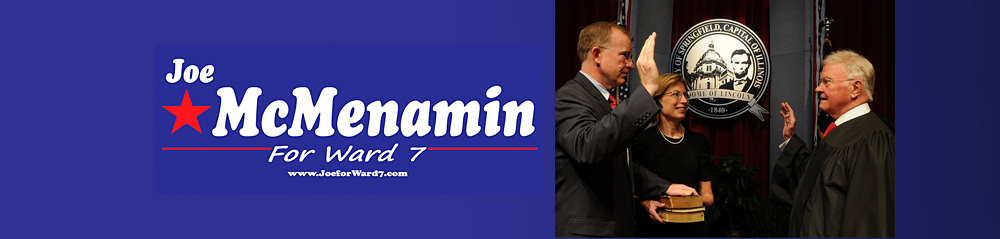
Langfelder has an ally in Ward 7 Ald. Joe McMenamin, who’s been targeted by unions and whose campaign for a third term may be the most interesting in the city. He says the mayor has done an “acceptable” job and deserves another term. He’s blunt about Edwards’ chances.
“It would be the upset of the half-century,” the alderman says.
If Langfelder has coattails, McMenamin is grabbing them in his race against Brad Carlson, a Capital Township trustee and chief of staff at the state Department of Natural Resources. “I’m very pleased to have a close relationship and close connection with Mayor Langfelder and the department directors,” the alderman says. His colleagues on the council, not so much.
McMenamin’s relationship with other aldermen is strained to the point that council members last year considered removing aldermen considered disruptive from meetings if two-thirds of the council voted to have them taken out. McMenamin – who’s exchanged sharp words with his colleagues for accepting campaign contributions from political parties, labor and vendors who do business with the city – isn’t backing down.
“The question of who owns the candidate is extraordinarily important,” says McMenamin, who boasts that he doesn’t take money from political parties, unions or entities that do business with the city. “It’s a question of character. Some aldermen are unwilling to vote in the city’s interest.”
What about Langfelder, who accepted union help during the 2015 campaign? That’s different, according to McMenamin.
“I’m impressed that when Brad Schaive and the laborers (union) gave 20 grand to Jim Langfelder, they acted like they owned him,” McMenamin says. “Jim Langfelder has basically been a strong enough mayor to say no to Brad Schaive on some issues, and I respect that.”
McMenamin has blasted other aldermen for gathering at Saputo’s restaurant in 2017 to accept campaign contributions from unions and developers. There were enough council members present to constitute a quorum, but aldermen who attended the gathering said they discussed no city business and so there was no violation of the state Open Meetings Act.
Was the gathering appropriate?
In any case, Ward 7 traditionally has high turnouts for municipal elections. In 2015, it had, with 44 percent of voters casting ballots, the second-highest turnout of any ward in the city, trailing only Ward 10, which had a 45 percent turnout. And so running a campaign in Ward 7 could prove more expensive than in other wards, where candidates will have fewer mailers to mail and fewer voters to sway, presuming they concentrate on voters who’ve cast ballots in past municipal elections.
***
 Joe McMenamin for Ward 7